As Microsoft Copilot Studio continues to evolve with autonomous agents and generative AI, it’s easy to assume that traditional Topics are no longer relevant. In reality, topics remain an essential part of building reliable and structured conversational experiences.
While generative AI is excellent at understanding natural language, there are many business scenarios where organisations need predictable workflows, clear decision points, and complete control over the conversation. That’s exactly where topics continue to shine.
What are Topics?
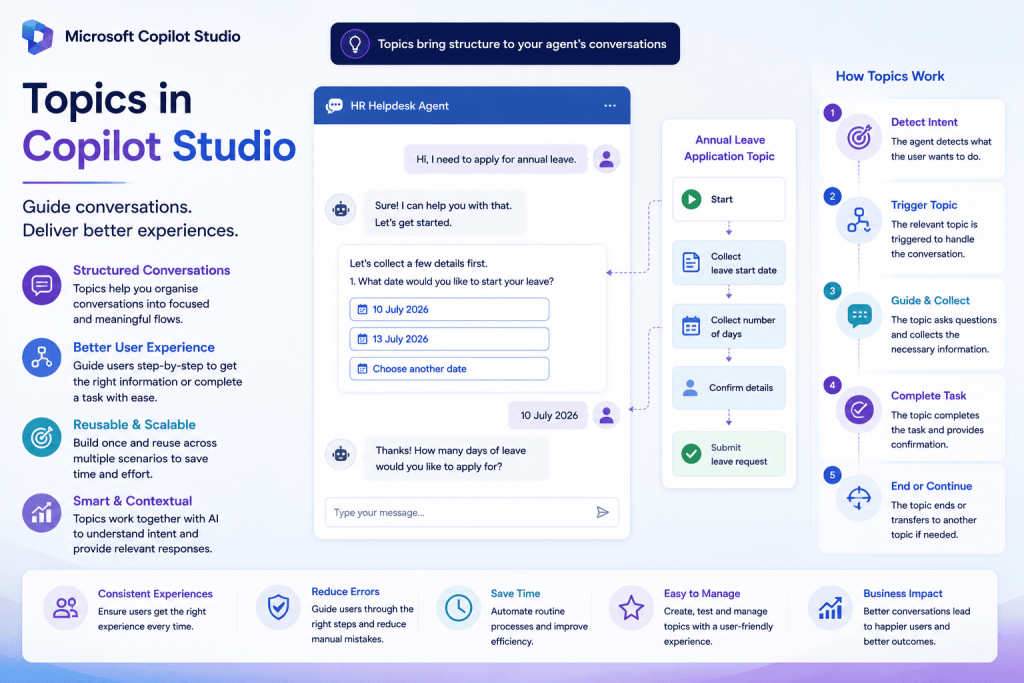
Topics are conversation flows that guide an AI agent through a predefined sequence of actions. Each topic is designed to handle a specific scenario, such as answering a frequently asked question, collecting information from a user, or performing a business process.
A topic is typically triggered when the user’s message matches one of its trigger phrases or when it’s called from another topic or agent action. From there, the conversation follows the logic you’ve designed, allowing the agent to ask questions, make decisions, and perform actions.
Why are Topics still important?
Generative AI works well for open-ended conversations, but not every business process should rely entirely on AI-generated responses.
Imagine an employee requesting annual leave or a customer reporting an issue. These processes often require mandatory information, validation steps, or approvals before they can continue.
Using a topic allows you to guide the conversation step by step, ensuring all required information is collected before the process moves forward. This creates a more consistent experience and reduces the likelihood of incomplete or incorrect requests.
Topics and generative AI work together
One of the biggest misconceptions is that organisations must choose between topics and generative AI.
In practice, the two complement each other.
A user might begin by asking a natural language question that the AI answers using generative capabilities. If the conversation then requires a structured process, such as creating a support request or booking an appointment, the agent can transition into a topic to guide the user through the required steps.
This combination allows organisations to offer both conversational flexibility and process reliability within the same AI agent.
When should you use a Topic?
Topics are particularly valuable whenever a conversation follows a defined business process. They’re well suited to scenarios where information must be collected in a specific order, decisions need to be made based on user input, or actions must be completed before the conversation can continue.
Examples include creating support tickets, submitting leave requests, registering new employees, booking appointments, collecting customer feedback, or escalating complex enquiries to a human agent.
In these situations, topics provide the structure needed to ensure every interaction is completed consistently.
Best practices
When designing topics, keep the conversation focused on a single objective. Large, complex topics can become difficult to maintain and test, so it’s often better to build smaller topics that can be reused across multiple scenarios.
It’s also worth taking advantage of generative AI where appropriate. Let AI answer open-ended questions, then transition into a topic when the user needs to complete a structured business process. This creates a more natural experience while maintaining control over important workflows.
Finally, test your topics regularly with real users to ensure trigger phrases, questions, and branching logic continue to meet business needs.
Final Thoughts
Topics remain one of the most important capabilities in Microsoft Copilot Studio. While autonomous agents and generative AI are transforming how conversations begin, structured business processes still require predictable and reliable workflows.
By combining the flexibility of AI with the control offered by topics, organisations can build intelligent agents that not only understand users but also help them complete real business tasks with confidence.