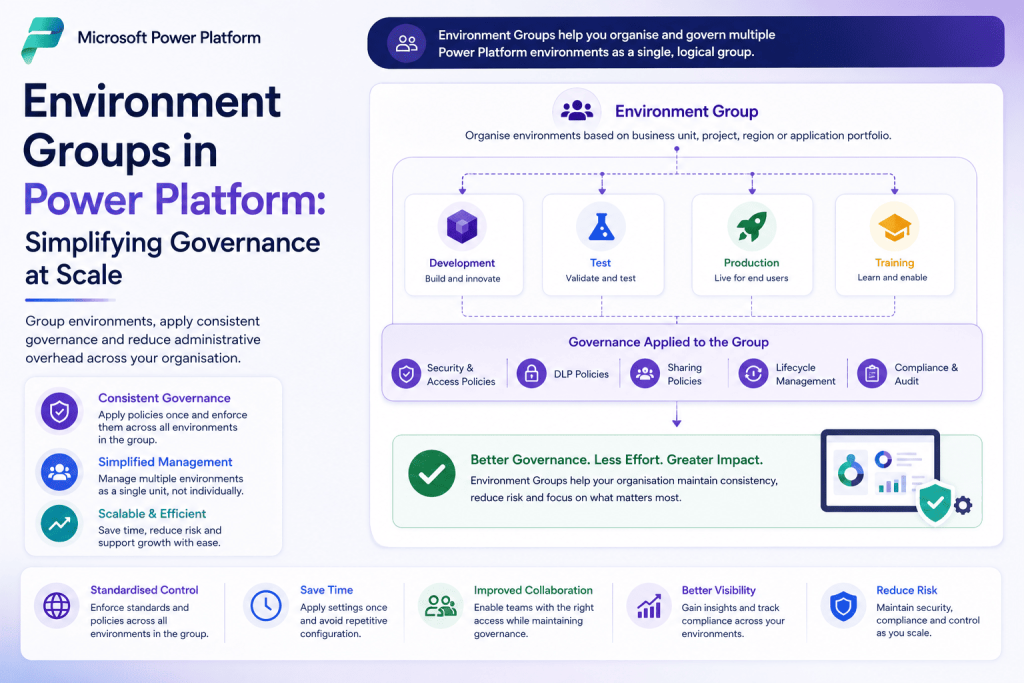
As Power Platform adoption grows, organisations often find themselves managing an increasing number of environments for development, testing, production, training, and experimentation. While this flexibility is valuable, it can also introduce governance challenges if each environment is managed independently.
Environment Groups help address this by allowing administrators to organise related environments and apply governance policies consistently across them. Rather than configuring settings one environment at a time, organisations can manage environments as logical groups, making administration simpler and more scalable.
What are Environment Groups?
Environment Groups allow multiple Power Platform environments to be organised under a single management structure.
Instead of treating every environment as a separate entity, administrators can group environments based on business units, departments, projects, or regions. Governance settings can then be applied consistently across the entire group, reducing repetitive administration and helping maintain organisational standards.
This approach becomes increasingly valuable as organisations expand their Power Platform footprint.
Why do they matter?
Managing a handful of environments manually is relatively straightforward. Managing hundreds of environments is a very different challenge.
Without a consistent governance model, different environments can end up with different security settings, connector policies, or compliance configurations. Over time, these inconsistencies increase administrative effort and introduce unnecessary risk.
Environment Groups simplify this by allowing administrators to standardise governance across multiple environments while maintaining flexibility where needed.
A practical example
Imagine a global organisation with separate Power Platform environments for Australia, New Zealand, Singapore, and the United Kingdom.
Rather than configuring governance settings individually for each environment, administrators can organise these environments into logical groups and apply common policies at the group level. As new environments are created, they can inherit the same governance approach, reducing setup time and improving consistency.
This makes it much easier to support growth without increasing administrative complexity.
Supporting enterprise governance
Environment Groups fit naturally into a broader governance strategy.
When combined with Data Loss Prevention (DLP) policies, Managed Environments, and Power Platform Pipelines, they help organisations establish a more structured and secure platform. Administrators spend less time applying repetitive configurations and more time focusing on strategic governance and platform adoption.
For organisations operating across multiple regions or business units, this can significantly reduce operational overhead.
Best practices
Environment Groups should be designed around how your organisation operates rather than simply grouping environments by name.
Consider organising environments by business function, geographic region, or application portfolio so governance policies align naturally with organisational structure.
It’s also worth reviewing group membership regularly as projects evolve. Keeping environments organised ensures governance remains effective as new applications and teams are introduced.
Final Thoughts
Environment Groups are an important addition to the Power Platform governance toolkit. They help organisations move beyond managing environments individually and instead adopt a more scalable, structured approach to administration.
As Power Platform continues to grow across the enterprise, features like Environment Groups will become increasingly important for maintaining consistency, reducing administrative effort, and supporting long-term platform governance.