As Power Platform adoption accelerates across organisations, maintaining governance becomes just as important as building applications. Without the right controls, environments can quickly become difficult to manage, leading to inconsistent development practices, security risks, and limited visibility into platform usage.
Managed Environments help organisations address these challenges by introducing governance capabilities that improve visibility, encourage best practices, and simplify administration without restricting innovation.
What are Managed Environments?
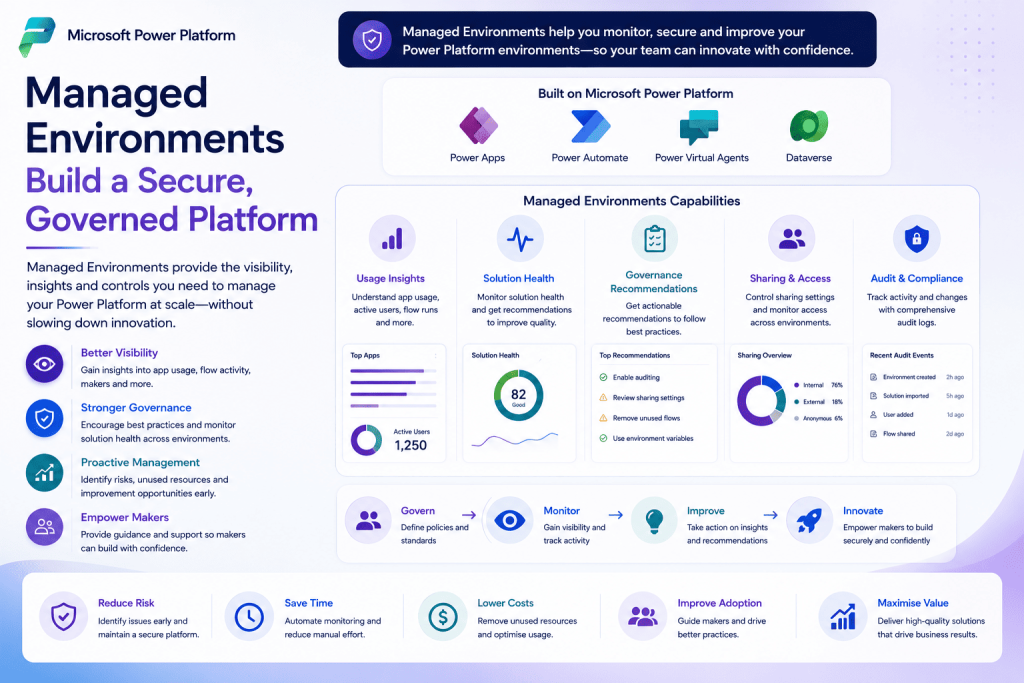
Managed Environments are a set of governance features designed to help administrators oversee Power Platform environments more effectively.
Rather than changing how makers build applications, Managed Environments provide additional administrative capabilities such as usage insights, solution health monitoring, governance recommendations, and sharing controls.
The goal isn’t to slow development down—it’s to ensure applications are built in a secure, well-managed, and sustainable way.
Why are they important?
Many organisations begin their Power Platform journey with only a few applications. As adoption grows, so does the number of apps, flows, environments, and makers.
Without governance, administrators often struggle to understand which applications are actively used, which solutions may present risks, and where additional oversight is required.
Managed Environments provide the visibility needed to answer these questions, helping organisations make informed decisions while maintaining confidence in their Power Platform estate.
A practical example
Imagine a large organisation with hundreds of Power Apps and Power Automate flows created across multiple departments.
Instead of manually reviewing each environment, administrators can use Managed Environments to gain insights into application activity, identify unused resources, monitor solution health, and encourage makers to follow organisational standards.
This allows governance to become proactive rather than reactive, reducing administrative effort while improving platform quality.
Supporting enterprise governance
Managed Environments work particularly well alongside other governance capabilities within the Power Platform.
Combined with Environment Groups, organisations can organise environments logically. Power Platform Pipelines provide controlled application deployments, while Data Loss Prevention (DLP) policies help protect sensitive business data.
Together, these features create a governance framework that supports innovation without compromising security or compliance.
Best practices
Managed Environments should be enabled for environments that support business-critical applications or are shared across multiple teams.
Organisations should regularly review the available insights and recommendations, treating them as an opportunity to improve governance rather than simply monitoring activity.
It’s also important to educate makers about governance expectations. Managed Environments are most effective when administrators and makers work together to maintain high-quality solutions.
Final Thoughts
Managed Environments represent an important step in the evolution of Power Platform governance. Rather than focusing solely on administration, they provide organisations with the tools needed to monitor, improve, and scale their Power Platform estate confidently.
As businesses continue building more applications with low-code technologies, governance will become increasingly important. Managed Environments help ensure that innovation and control can grow together.