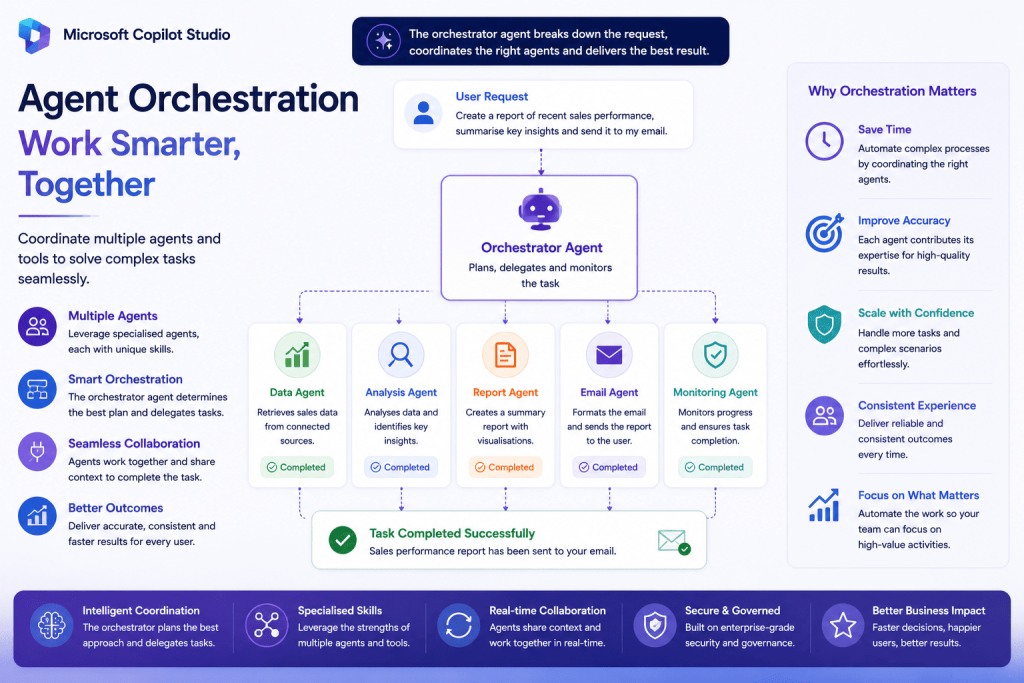
As AI agents become more capable, organisations are moving beyond the idea of building one agent that does everything. Instead, they’re creating multiple specialised agents, each responsible for a specific business function.
This is where Agent Orchestration comes in.
Rather than expecting a single AI agent to answer every question or complete every task, Copilot Studio can intelligently coordinate multiple agents, allowing each one to contribute where it performs best. The result is a more scalable, maintainable, and intelligent AI solution.
What is Agent Orchestration?
Agent Orchestration is the ability for one AI agent to collaborate with other specialised agents to complete a user’s request.
Instead of building one large agent containing every business process, organisations can create smaller agents that focus on areas such as HR, IT, Finance, Customer Service, or Sales. When a user submits a request, Copilot Studio determines which agent is best suited to handle that part of the conversation.
From the user’s perspective, the experience feels seamless, even though multiple agents may be working together behind the scenes.
Why does it matter?
As organisations expand their AI capabilities, maintaining a single, all-purpose agent becomes increasingly difficult. Large agents are harder to manage, more complex to test, and often contain knowledge that isn’t relevant to every user.
Agent Orchestration solves this by encouraging a modular approach. Each agent is responsible for a well-defined area, making it easier to maintain, update, and improve without affecting the rest of the solution.
This approach also allows different business teams to manage their own agents while still contributing to a unified employee or customer experience.
A practical example
Imagine an employee asks:
“I’m joining the company next week. Can you help me get everything ready?”
Rather than expecting one agent to complete every task, an orchestrated solution can coordinate multiple specialised agents.
The HR agent can explain onboarding requirements, the IT agent can arrange system access and equipment, while the Facilities agent can provide office information. The employee experiences a single conversation, but several agents contribute to delivering the complete response.
This makes complex business processes feel simple and connected.
Building scalable AI solutions
One of the biggest advantages of Agent Orchestration is scalability.
As business requirements evolve, organisations can introduce new specialised agents without redesigning the entire solution. Existing agents continue to perform their own responsibilities while new capabilities are added independently.
This modular architecture also reduces duplication. Instead of recreating common business logic across multiple projects, organisations can reuse existing agents whenever similar requirements arise.
Best practices
Successful orchestration begins with defining clear responsibilities for each agent. Avoid creating multiple agents that perform the same task, as this can introduce unnecessary complexity.
It’s equally important to design agents that work well together. Consistent naming, well-defined knowledge sources, and clearly scoped responsibilities make it easier for Copilot Studio to route requests appropriately.
Finally, monitor how users interact with your agents. Understanding where conversations are handed over between agents can help identify opportunities to improve both the user experience and the overall solution.
Final Thoughts
Agent Orchestration represents an important step towards building enterprise-scale AI solutions in Microsoft Copilot Studio. Rather than relying on one large AI agent, organisations can combine multiple specialised agents that collaborate to solve complex business problems.
As AI continues to become part of everyday business operations, this modular approach offers greater flexibility, easier maintenance, and a better experience for both employees and customers.