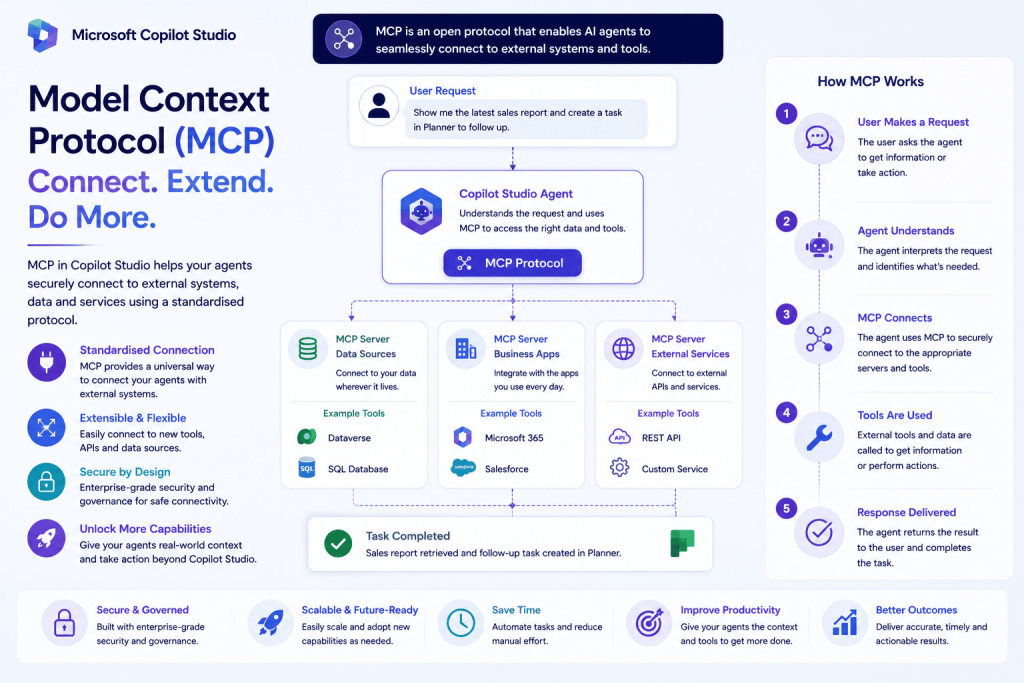
As AI agents become more capable, they’re expected to do far more than answer questions. They need to retrieve business data, interact with external systems, execute actions, and work across multiple applications. Traditionally, every integration required custom APIs, connectors, or bespoke development.
The Model Context Protocol (MCP) is changing this approach.
Instead of building a separate integration for every AI application, MCP provides a standard way for AI agents to discover and interact with external tools and services. As Microsoft continues investing in open AI ecosystems, MCP is becoming an important part of building scalable and interoperable AI solutions.
What is Model Context Protocol?
Model Context Protocol is an open standard that allows AI models to communicate with external tools and services through a consistent interface. Rather than creating custom integrations for every system, developers can expose capabilities through an MCP server, making them available to compatible AI agents.
Think of it as a common language that allows AI agents to discover what tools are available, understand what each tool can do, and invoke those tools when they’re needed.
This makes it much easier to extend an AI agent without constantly rebuilding integrations.
Why is MCP important?
Modern organisations rarely rely on a single application. Business data is often spread across CRM systems, ERPs, internal portals, cloud services, and legacy applications.
Without a standard approach, connecting AI agents to these systems can quickly become complex.
MCP simplifies this by allowing AI agents to access multiple tools using a consistent protocol. Instead of learning a different integration method for every application, the agent communicates through a standard interface, making solutions easier to build and maintain.
As more software vendors adopt MCP, organisations will be able to connect AI agents to an increasingly wide range of business systems.
MCP and Copilot Studio
Microsoft is embracing MCP as part of its vision for enterprise AI.
Within Copilot Studio, MCP allows agents to work with external tools beyond the platform’s built-in capabilities. Rather than limiting an agent to predefined connectors, organisations can expose business functionality through MCP and allow the agent to invoke those capabilities when appropriate.
This creates a more flexible architecture where AI agents can interact with a growing ecosystem of business applications without requiring every integration to be built differently.
A practical example
Imagine an employee asks an AI agent:
“Can you check whether my laptop has been ordered?”
The answer may not exist inside Microsoft 365 or Dataverse. Instead, the information could be stored in an internal procurement system.
If that procurement platform exposes its functionality through an MCP server, the agent can retrieve the order status and present the information to the employee as part of the conversation.
From the user’s perspective, it’s a simple question and answer. Behind the scenes, the AI agent has discovered the appropriate tool, executed it, and returned the result—all without the user needing to know where the data came from.
Best practices
As organisations begin adopting MCP, it’s important to treat it as part of an overall integration strategy rather than a replacement for every existing API.
Security, authentication, and governance remain critical. MCP should only expose business capabilities that users are authorised to access, and organisations should carefully manage which tools are available to their AI agents.
It’s also worth designing tools with clear responsibilities so agents can reliably determine which capability should be used for a given task.
Final Thoughts
Model Context Protocol represents an important step towards a more connected AI ecosystem. Rather than building isolated AI solutions, organisations can create agents that interact with a growing network of business tools through a common standard.
As Microsoft Copilot Studio continues to evolve, MCP is likely to play an increasingly important role in extending AI agents beyond traditional connectors and enabling more intelligent, integrated business solutions.