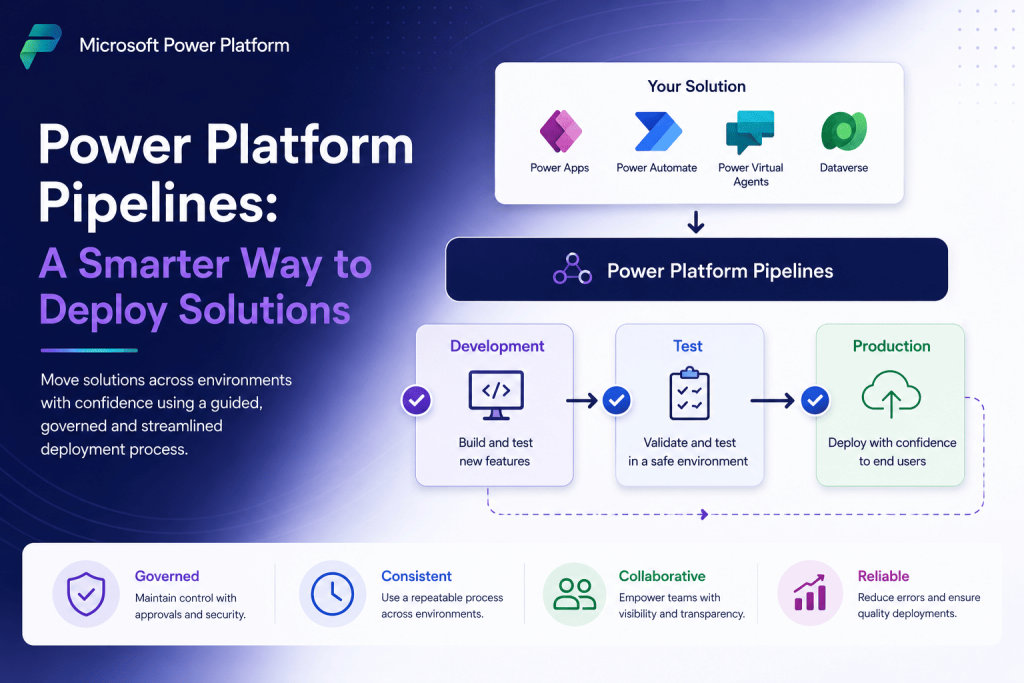
Building a Power Platform solution is only part of the journey. Moving that solution safely from development to testing and eventually into production is just as important. Unfortunately, many organisations still rely on manual exports and imports, making deployments time-consuming and increasing the risk of mistakes.
Power Platform Pipelines provide a more structured approach by allowing makers to deploy solutions through predefined environments using a guided and governed process. Instead of manually managing solution files, organisations can standardise deployments while maintaining control over every stage of the application lifecycle.
What are Power Platform Pipelines?
Power Platform Pipelines are a built-in deployment capability that helps organisations move solutions between environments in a consistent and controlled manner.
Rather than exporting a managed or unmanaged solution and importing it into another environment, makers can submit a deployment through a pipeline. The platform then manages the deployment process based on the environments and approvals that have been configured.
This provides a much simpler deployment experience while reducing the chance of human error.
Why do Pipelines matter?
As Power Platform adoption grows, applications often move through several environments before reaching production. Development teams may build new features in one environment, testers validate them in another, and business users expect reliable deployments into production.
Without a standard deployment process, it’s easy for solutions to become inconsistent or for changes to be deployed accidentally.
Power Platform Pipelines introduce governance without adding unnecessary complexity. They ensure deployments follow a repeatable process while giving administrators greater visibility into what is being deployed and when.
A practical example
Imagine a team has developed a new approval process using Power Apps, Power Automate, and Dataverse.
Once development is complete, the maker doesn’t need to manually export and import the solution across multiple environments. Instead, they submit the solution through a configured pipeline. The deployment progresses through the Test environment, where it can be validated, before moving into Production after the required approval.
The entire process is more structured, easier to track, and significantly less prone to deployment errors.
Benefits for organisations
Power Platform Pipelines help establish a more mature application lifecycle without requiring specialist DevOps knowledge.
Development teams gain a consistent deployment experience, administrators retain greater control over production environments, and organisations reduce the risks associated with manual deployments.
As more applications are built on the Power Platform, having a reliable deployment process becomes increasingly important for maintaining quality and governance.
Best practices
Pipelines work best when they’re introduced alongside a well-defined environment strategy. Development, Test, and Production environments should each have a clear purpose, and solution changes should progress through them in a predictable order.
It’s also worth using managed solutions for production deployments and ensuring makers understand the importance of versioning. Together, these practices help maintain consistency and simplify future updates.
Finally, regularly review deployment history and permissions to ensure the pipeline continues to align with your organisation’s governance requirements.
Final Thoughts
Power Platform Pipelines make application deployment simpler, safer, and more consistent. By replacing manual solution movement with a governed deployment process, organisations can improve reliability while reducing the effort required to release new features.
For teams building business-critical applications on the Power Platform, Pipelines represent an important step towards a more professional and scalable development lifecycle.